

What Should a CA or CMA Student Learn Beyond the Syllabus?

What Should a CA or CMA Student Learn Beyond the Syllabus?
Becoming a Chartered Accountant (CA) or Cost and Management Accountant (CMA) requires dedication, consistency, and strong conceptual knowledge. However, in today's competitive job market, simply completing the CA or CMA syllabus may not be enough.
Employers increasingly look for candidates who can combine professional knowledge with practical skills, technology skills, analytical thinking, communication, and business understanding.
Why Should CA and CMA Students Learn Beyond the Syllabus?
The CA and CMA curriculum provides students with a strong foundation in accounting, taxation, auditing, costing, financial management, and other important areas.
However, professional life can involve much more than theoretical knowledge.
A finance professional may need to:
Analyse large amounts of financial data
Prepare management reports
Build financial models
Work with Excel and ERP systems
Create dashboards
Explain financial information to management
Analyse business performance
Use technology and AI tools
Solve practical business problems
This is why developing practical skills for CA and CMA students can be an important part of career preparation.
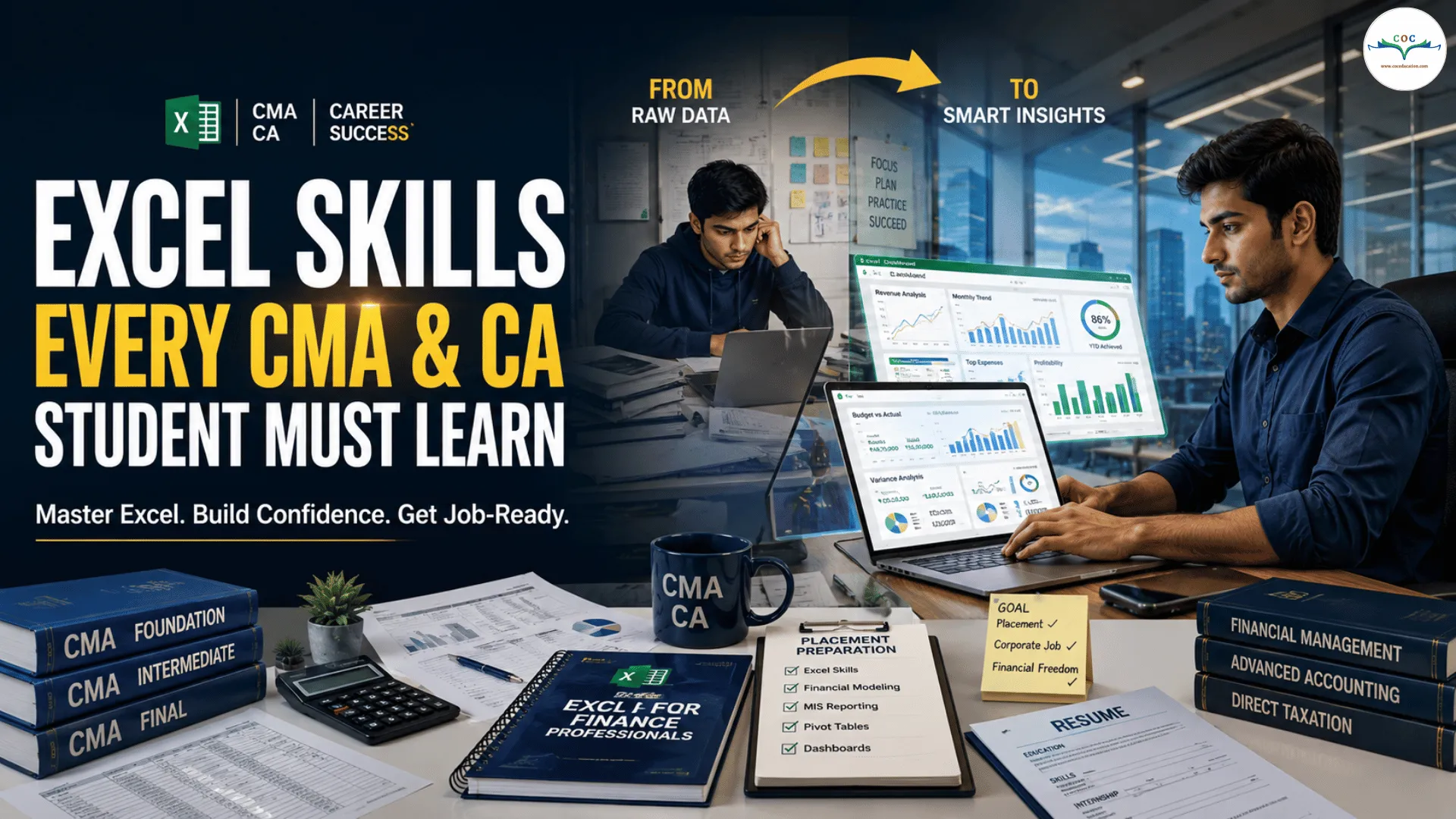
1. Advanced Excel Skills
Advanced Excel is one of the most useful technical skills for CA and CMA students.
Excel is widely used for financial analysis, reporting, budgeting, forecasting, reconciliation, and data management.
CA and CMA students should consider learning:
XLOOKUP and VLOOKUP
INDEX and MATCH
SUMIFS and COUNTIFS
IF and nested IF formulas
Pivot Tables
Conditional Formatting
Data Validation
Charts and dashboards
Data cleaning
Financial analysis
Basic Excel automation
Instead of learning Excel only through tutorials, students should practise by creating real financial reports, budgets, MIS reports, and analysis sheets.
2. Financial Modelling
Financial modelling is another valuable skill for CA and CMA students interested in finance careers.
Financial models can be used to forecast business performance and support financial decision-making.
Students can learn how to create models for:
Revenue forecasting
Expense forecasting
Profit and Loss projections
Cash-flow forecasting
Budgeting
Scenario analysis
Business valuation
Investment analysis
Learning financial modelling can help students understand how financial concepts are applied to real-world business situations.
3. Data Analytics and Power BI
The finance industry is becoming increasingly data-driven. As a result, data analytics skills for CA and CMA students can provide useful practical exposure.
Students can explore tools such as Microsoft Power BI and learn how to convert financial data into meaningful dashboards and reports.
Useful areas include:
Data cleaning
Data analysis
Dashboard creation
KPI reporting
Financial data visualisation
Management reporting
Trend analysis
For example, instead of simply presenting monthly sales numbers, a finance professional may need to identify sales trends, profitability changes, and key performance indicators.
4. ERP and Accounting Software
Knowing accounting concepts is important, but understanding how finance processes work through business software can also be valuable.
CA and CMA students can explore ERP and accounting platforms such as:
SAP
Oracle
Tally
Microsoft Dynamics
Other accounting and ERP systems
Students should understand basic business processes such as:
Purchase ? Invoice ? Payment ? Accounting Entry ? Reporting
This can help connect theoretical accounting knowledge with practical business processes.
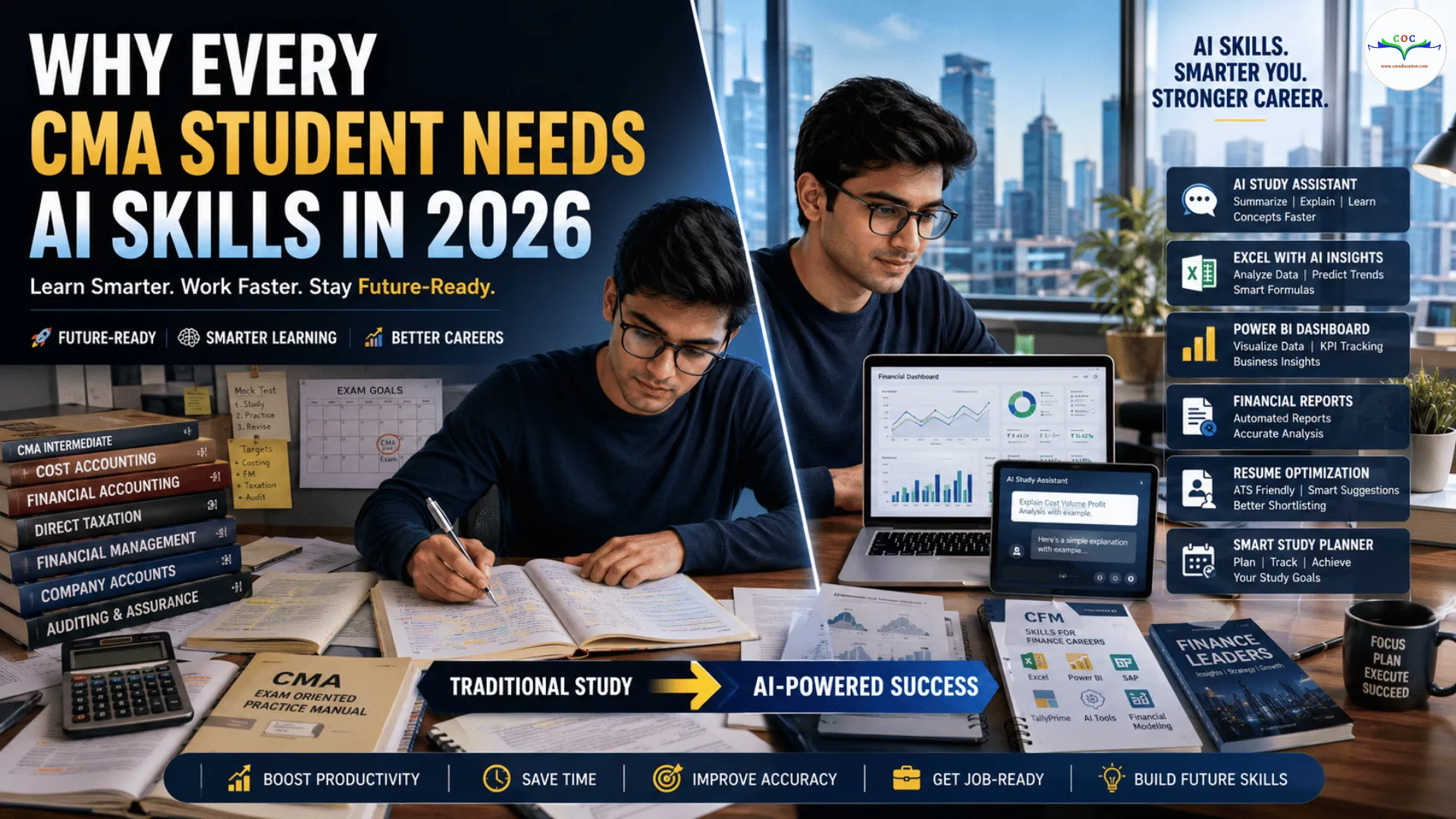
5. Artificial Intelligence and Automation
AI is becoming increasingly relevant across the finance and accounting industry.
Therefore, AI skills for finance students are becoming an important area to explore.
CA and CMA students can learn how AI and automation may be used for:
Data analysis
Financial reporting
Document processing
Reconciliation
Research
Report generation
Workflow automation
Productivity improvement
Students should also understand the importance of reviewing AI-generated information and applying their own professional judgement.
AI should be viewed as a productivity tool, not a replacement for professional knowledge and critical thinking.
6. Financial Statement Analysis
CA and CMA students already study financial statements, but they should also practise analysing them from a business perspective.
Important areas include:
Ratio analysis
Profitability analysis
Liquidity analysis
Solvency analysis
Cash-flow analysis
Working-capital analysis
Trend analysis
Comparative analysis
For example, don't just look at whether a company's revenue increased.
Ask:
Did profit increase at the same rate?
Did margins improve or decline?
Did debt increase?
How has cash flow changed?
This approach helps develop practical financial analysis skills.
7. Business and Commercial Awareness
A successful finance professional needs to understand more than accounting numbers.
CA and CMA students should develop basic business awareness by learning about:
Business models
Revenue generation
Pricing
Profit margins
Recent Posts