

How to Make Effective CMA Notes for Revision
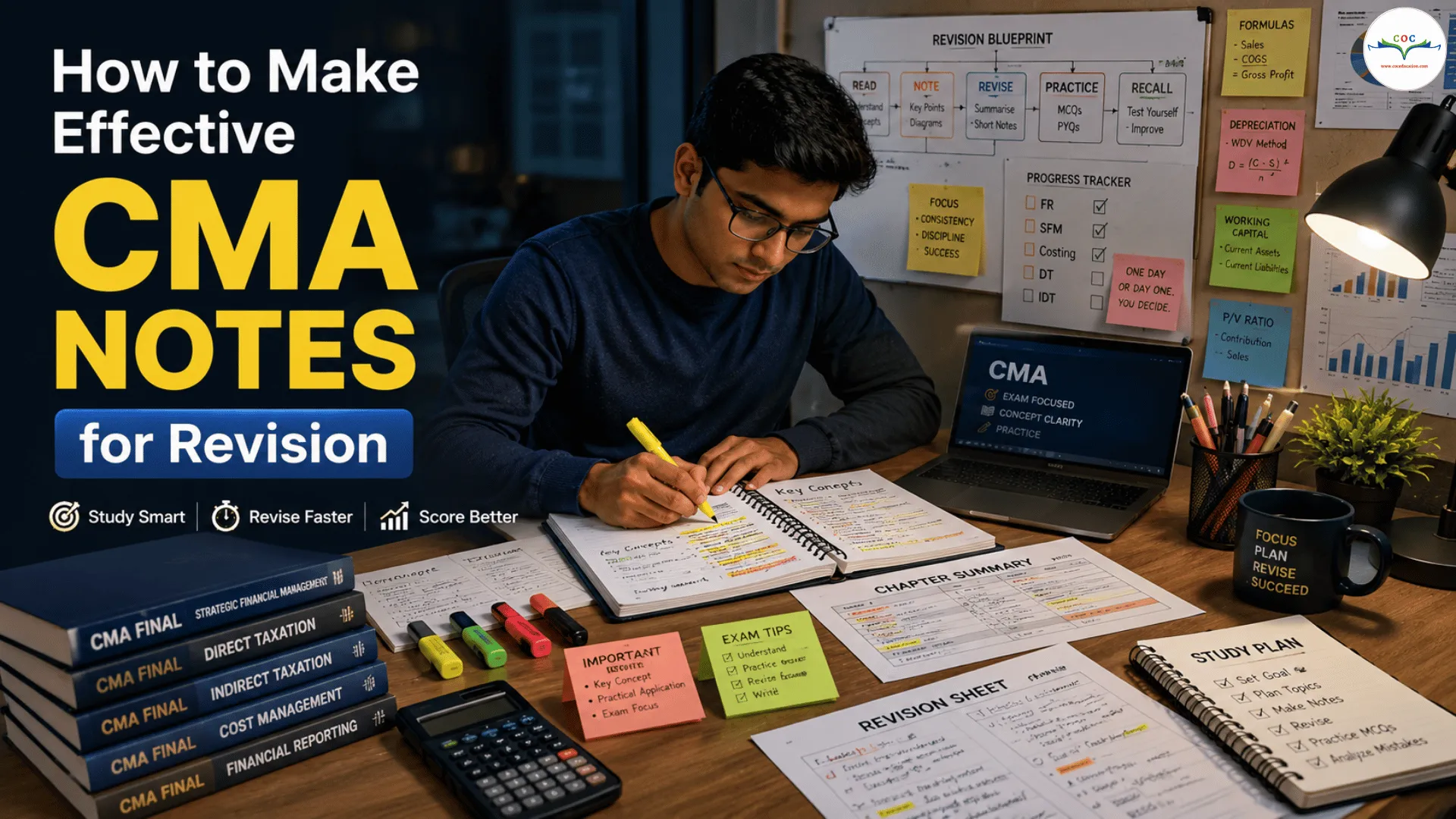
How to Make Effective CMA Notes for Revision
Preparing for CMA exams requires more than just reading textbooks and watching lectures. One of the most powerful tools for exam success is creating effective revision notes. Well-organized notes help students revise faster, retain concepts better, and improve confidence before exams. Many CMA toppers credit their success to smart note-making techniques that make revision efficient and stress-free. In this blog, we'll discuss how to create effective CMA notes that can help you maximize your exam performance.
Why Are Revision Notes Important for CMA Students?
The CMA syllabus is vast and includes multiple subjects, formulas, concepts, accounting standards, laws, and practical problems.
Benefits of Good Revision Notes
Save time during revision
Improve concept retention
Help in last-minute preparation
Highlight important examination points
Reduce dependency on bulky textbooks
Make revision more structured and focused
Instead of revising entire books repeatedly, students can quickly revise key concepts using their notes.
Save time during revision
Improve concept retention
Help in last-minute preparation
Highlight important examination points
Reduce dependency on bulky textbooks
Make revision more structured and focused
Start Making Notes from Day One
One common mistake students make is waiting until the exam is near before creating notes.
Why Early Note-Making Matters
When you prepare notes during your first reading:
Concepts become easier to understand
Important points are identified immediately
Revision becomes much faster later
You avoid last-minute pressure
Make note-making a part of your daily study routine.
Concepts become easier to understand
Important points are identified immediately
Revision becomes much faster later
You avoid last-minute pressure
Keep Notes Short and Concise
Revision notes should simplify learning, not create another textbook.
What to Include
Important concepts
Key definitions
Formulas
Amendments
Practical formats
Frequently asked questions
Important concepts
Key definitions
Formulas
Amendments
Practical formats
Frequently asked questions
What to Avoid
Long paragraphs
Unnecessary explanations
Excessive examples
Complete textbook content
Your notes should provide quick revision within minutes.
Long paragraphs
Unnecessary explanations
Excessive examples
Complete textbook content
Use the One-Page Rule
For major topics, try summarizing the entire chapter on one or two pages.
Example
For IND AS, include:
Objective
Scope
Recognition criteria
Measurement principles
Key disclosures
Important examination points
This method helps students revise entire chapters quickly before exams.
Highlight Important Information
Visual learning improves memory retention.
Objective
Scope
Recognition criteria
Measurement principles
Key disclosures
Important examination points
Use Different Colors For
Important concepts
Formulas
Amendments
Frequently asked examination points
Color coding makes revision faster and more effective.
Create Formula and Concept Sheets
Certain CMA subjects require memorization of formulas and calculations.
Subjects Where Formula Sheets Help
Financial Management
Cost Accounting
Strategic Financial Management
Operations Management
Business Analytics
Keep all important formulas on separate revision sheets for quick review.
Financial Management
Cost Accounting
Strategic Financial Management
Operations Management
Business Analytics
Prepare Summary Notes for Practical Subjects
Practical subjects require structured presentation.
Include
Journal entry formats
Financial statement formats
Cost sheet formats
Working note structures
Standard problem-solving approaches
These summaries help during exam writing practice.
Journal entry formats
Financial statement formats
Cost sheet formats
Working note structures
Standard problem-solving approaches
Use Flowcharts and Mind Maps
Complex topics become easier when presented visually.
Best Topics for Mind Maps
Costing concepts
Strategic Management
Corporate Laws
Taxation provisions
Accounting Standards
Flowcharts help connect concepts and improve recall during exams.
Costing concepts
Strategic Management
Corporate Laws
Taxation provisions
Accounting Standards
Maintain a Separate Amendment Notebook
Professional courses frequently introduce amendments and updates.
Your Amendment Notebook Should Include
Latest notifications
New provisions
Important changes
Effective dates
This notebook becomes extremely valuable during final revision.
Latest notifications
New provisions
Important changes
Effective dates
Add Exam-Oriented Points
While making notes, think from an examiner's perspective.
Include
Frequently asked questions
Past examination trends
Important case studies
Common mistakes to avoid
This approach improves scoring opportunities.
Frequently asked questions
Past examination trends
Important case studies
Common mistakes to avoid
Keep Digital and Physical Notes
Both formats have advantages.
Physical Notes
Better retention
-
Recent Posts
Better retention